One Christmas present arrived early: My new book

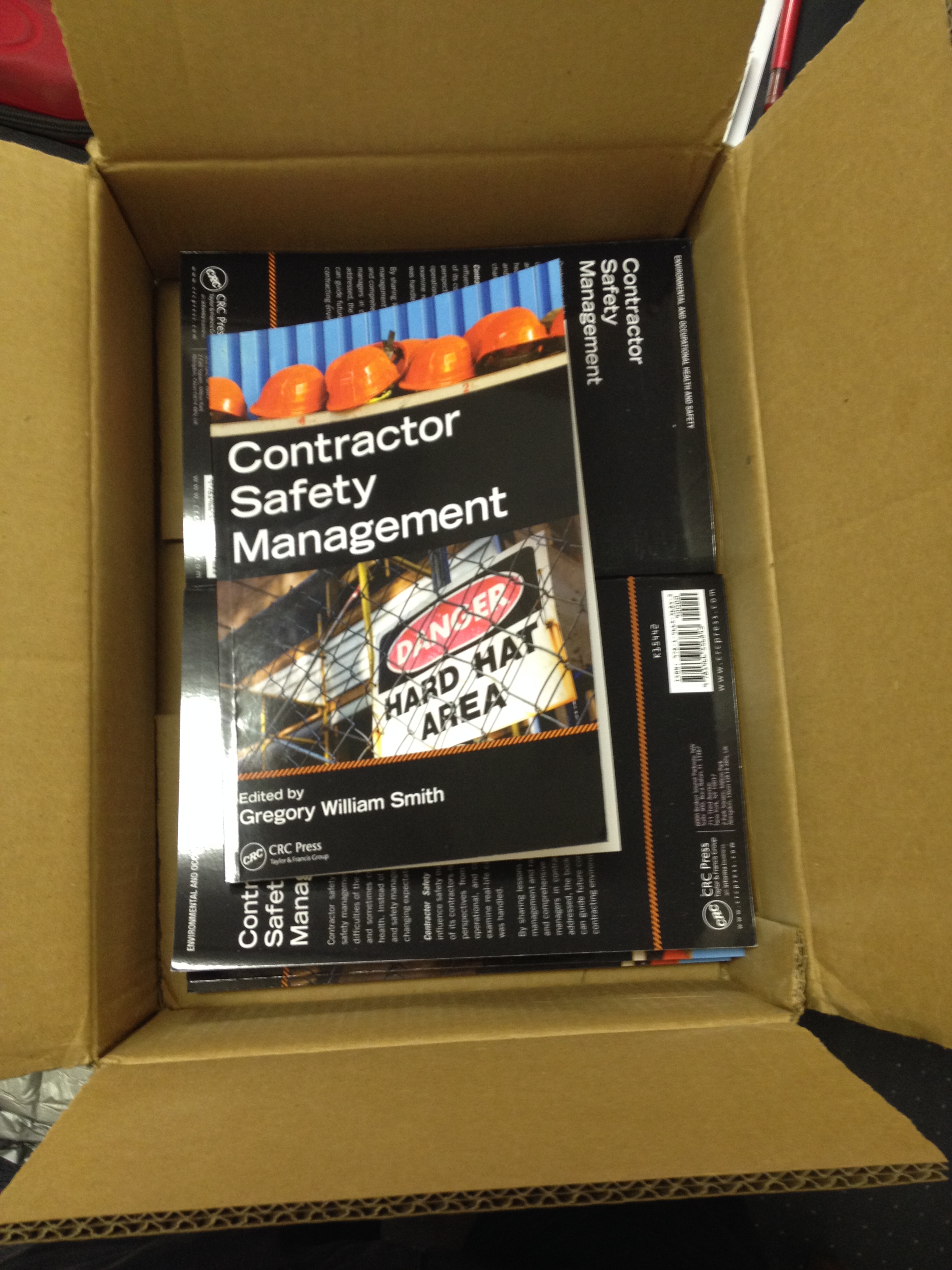
After what has been a terrible day with technology and online frustration, a parcel has just arrived with my new book on Contractor Safety Management.

Book 1

Heartfelt thanks to all of the contributing authors who made this possible:

  • Fiona Murfitt
  • Olga Klimczak
  • Sarina M. Maneotis
  • Dr Janis Janz
  • Pat Gilroy AM
  • Dr Elias Choueiri
  • Tristan Casey
  • Dr Autumn Krauss

So, with the day looking a little brighter, it is time to grab the team and open some cold drinks.

Merry Christmas to all of you who have followed the blog this year. Thank you for all of your support, and all the best for 2014.

Do we need to rethink safety prosecutions?

I have seen a number of recent posts and comments on various sites, noting where company executives have been prosecuted and jailed for health and safety breaches. The general tone of the observations has been that this is an approach that should be adopted in Australia, and that the relevant authorities should be far more active in pursuing these types of prosecutions.

Set out below is an article that I did for IFAP in Western Australia. It appears in the December issue of SafetyWA.

The article suggests that there might be more to a prosecution approach than meets the eye, and perhaps even an argument that safety prosecutions could undermine the end goal of trying to achieve “safe” workplaces.

I am not trying to suggest a “correct” approach, but like so much that we do in safety, we should not just assume that a prosecution approach is right. Perhaps it is time for the genuine debate and critical thinking that was missed during the harmonization process.

The value of safety prosecutions in Western Australia

Criminal prosecutions for safety and health breaches are generally regarded as an important element of effective regulation of safety and health behaviour. Part of that is the commonly accepted belief that the higher the penalties for health and safety breach, the more effective the deterrent effect of prosecution is likely to be.

I, for one, am not entirely convinced that prosecutions are in fact an effective measure for improved safety performance (ironic from a lawyer, I know).

Some studies have suggested that criminalising safety breaches can have an adverse effect on safety (See for example, International Journal of Applied Aviation Studies, Volume 10, Number 1, 2010, page 31 on).

Australian studies have shown that the vast majority of prosecutions of “Company Officers”, have been of small businesses – directors who are “hands on” in the business (see for example Foster, N. (2005) Personal Liability of Company officers for Corporate Health and Safety Breaches: Section 26 of the Occupational Health and Safety Act 2000 (NSW). 18 Australian Journal of Labour Law, 107). This obviously calls into question the equity of offences aimed at Company Officers.

Anecdotally, my own experience is that the response of many organisations to increased legal liability for safety and health breaches is not improved safety risk management, but improved legal risk management. Just witness the harmonisation debate over the last 5 years – a debate that has been lead almost entirely by legal commentators, not the safety profession.

The psychology here is also interesting.

A number of years ago, while working as principal safety advisor at Woodside Energy, some people far cleverer than me in the area of safety culture advised that to change human behaviour, the best strategies were to ensure that consequences for individuals were:

  • Certain;
  • Immediate; and
  • Positive.

If people always got immediate, positive feedback whenever they did the right thing for safety, then this would drive the right behaviour.

The least effective way to drive change? Consequences that are uncertain, delayed and negative (think safety prosecutions!)

Leaving aside for one moment broader philosophies about safety prosecution in general, what value do they provide to the understanding of safety management

In October 2013, BHP Billiton Iron Ore and HWE Newman Services were convicted and ordered to pay a total of $363,000 in safety fines and costs, after a mobile maintenance supervisor was killed while working on the tyre of a heavy earth mover in Western Australia.

The worker was fatally struck by a tyre handler device, which sprung off the tyre when it was overinflated.

The incident occurred in August 2008

There is a well-worn saying that justice delayed is justice denied. Similarly, safety lessons delayed are safety lessons lost, and in this case the lessons learned are not available to us until 5 years after the event? Except that they aren’t.

The prosecution occurred in the Magistrate’s court, and decisions are not freely available or published. There is no published judgement that we can look to, to understand the safety management failures behind the event. It seems that the sum total of information that might have generated valuable insights into important safety management failures around risk management, contractor safety management or other critical safety management elements is – zero

I have been involved in safety law and safety management for the best part of 24 years. There are some things I know, and an enormous number of things that I do not know. But one thing that I do know to an absolute certainty is that organisations do not examine their safety management systems with anywhere near the level of rigour that they are subject to in legal proceedings. For all its faults, the legal process has the potential to offer some genuine insights into the failure of safety management, but clearly, that potential cannot be realised where cases take years to finalise, and there is no record of the findings to review.

Perhaps it is time to re-examine the role of prosecution and inquiry in safety management and to think differently about what the response to safety failures ought to be. Certainly, the current approach cannot be blindly accepted as adding value.
Changes to Western Australia’s Dangerous Goods regulation

From 1 January 2014 a number of changes to how “dangerous goods” are regulated in Western Australia take effect, including repealing the Dangerous Good Safety (Goods in Ports) Regulations 2007 .

You can review the changes in our legal compliance database by accessing the link below:

www.lawstream.com.au

Username:  DGtest

Password: password

(Username and password are both case-sensitive)

This is a read only access, and will only be available for 2 weeks.

You can review the amendments in the update tabs when you navigate to the individual sections of the legislation. For example, if you go to regulation 239 of the Dangerous Goods Safety (Road and Rail Transport of Non-Explosives) Regulations 2007 and click on the update tab, you will see a redlined explanation of the amendment. Unless otherwise noted, information under the legislation tab is current legislation.

Also note, that new parts of the legislation (to take effect from 1 January) are set out in the “tree view” on the right hand side of the page. Relevant parts are followed by the notation “(this section takes effect from 1 January 2013)”.

If you have any problems reviewing the information or would like an online demonstration of the database, contact me by email at gsmith@stegroup.com.au

Please Note: Lawstream subscribers receive an email alert advising them of all changes to legislation they are subscribed to, as well as advice about whether the amendments are substantive or administrative.

Contractor safety management series Part 5: KCGM v Hanekom

Hi again everyone. Apologies for the break in posting over the last month, but all is explained in the video presentation below.

Today I  am looking at another case in our contractor safety management series.

KCGM v Hanekom involved a fatality on a mine site, and looks at the very interesting question of the extent of a Principal’s obligations when they impose safety obligations on a contractor. There is also the vexing question of what “liability” does a principal take on when they “approve” a contractor’s systems?

The upshot of the case is, I think, that If we impose health and safety obligations on our contractors we are responsible for:

  1. The “quality” of those obligations;
  2. Ensuring that those obligations are complied with

You can access a video presentation about the case here.

Contractor safety management series Part 4: The Queen v ACR Roofing

The Queen v ACR Roofing involved a fatality at a construction site, when a worker was electrocuted after a crane contacted overhead power lines. The worker was employed by a sub-contractor engaged by a 3rd party, and did not have any contractual relationship with ACR, the company that was prosecuted.

The case explores a number of interesting concepts, including whether a sub-contractor can be “engaged” when there is no contractual relationship. The case also explores the ongoing issue of “control” in a contracting relationship, and considers what role the relative “expertise” of the parties has in determining who has control.

You can access a video presentation about the case here.

Contractor safety management series Part 3: Nicholson v Pymble No 1

Nicholson v Pymble No 1 (Inspector Nicholson v Pymble No 1 Pty Ltd & Molinara (no 2) [2010] NSWIRComm 151) is not strictly speaking a contractor safety management case. However, it does involve a contracting relationship, but more importantly, it builds on the issues of “control” that we looked at in the last presentations.

Pymble had engaged a contractor to carry out construction work at the premises, and there were a number of allegations that the construction site was unsafe. Mr Molinara was a director of Pymble and lived in South Australia.

Pymble and Molinara were effectively charged on the basis that they were both (relevantly) “persons” with control of a premises being used by people as a place of work, and they failed to ensure that the premises were safe and without risk to health.

The case turned on whether Pymble and/or Molinara had relevant control.

You can see a short video presentation about the case here.

Contractor safety management series: Introduction

I have just finished finalising a presentation for a case involving the death of a worker employed by a subcontractor that was 2 companies removed from the Principal. The case involved the prosecution of the Principal in respect of a fatality.

Earlier this year I prepared a post and presentation on the Hillman v Ferro Con (SA) decision, which also involved the death of a worker employed by a contractor. You can access the blog post and video presentation here.

Contractor safety management seems to be an ongoing struggle for a lot of businesses, so I thought that I would do a series looking at a number of cases that examine the issues around contractor safety management. At the end of the series I will try to bring together a number of the issues raised to see if we can’t structure some key guiding principles.

At this stage, I am planning a series of 10 or 11 video presentations looking at some of the key cases across a number of jurisdictions over the last few years.

The first case in the series is Nash v Eastern Star Gas, a recent decision of the New South Wales Industrial Court which was handed down on 6 September 2013. You can access the blog post and video presentation here.

I hope you enjoy the series, and I look forward to any comments or feedback.

Conactor safety managment series Part 1: Nash v Eastern Star Gas

In August 2009, Bruce Austin a working director of a small business, The Saver Guys, died from head injuries after he was hit by a length of pipe that was being extracted from the ground.

Mr Austin’s business had been contracted by another entity, Applied Soil Technology Pty Ltd. The relevant work was being overseen by Austerberry Directional Drilling Services Pty Ltd, who had in turn been engaged by Eastern Energy Australia Ltd on behalf of a related corporation, Eastern Star Gas Ltd.

At the time of the accident, Mr Austin and others were trying to recover a blocked pipeline from under the ground.

Although a number of entities were prosecuted and convicted in relation to the fatality, this case looked at the safety management arrangements in place between Eastern Star Gas and Austerberry Directional Drilling. The case provides some useful insights into the expectations placed on businesses removed to an extent from the conduct of the physical work by a contractor. It also demonstrates how an organisations’ own, documented safety management systems (in this case a contractor safety management system) can be used to demonstrate that the organisation is not meeting its obligations.

You can access a copy of the decision here, and the video presentation here.

References in the Presentation:

Hillman v Ferro Con (SA)

Be careful what you wish for: Is the safety “profession” being sidelined?

Let me start with a few caveats and/or disclaimers.

First, this post has been inspired by a number of articles and discussions on line about the “practice” of safety and the safety “profession“. I only qualify profession because of the amount of disagreement about whether people who advise about safety are professionals, and what their role is.

Second, this is an outside looking in discussion (I am a lawyer by training and practice for the last 20+ years), and inside looking out (I run a combined law firm and safety consultancy, specialise in safety management and have been a senior health and safety adviser in the oil and gas industry).

Finally, this is a top down view. Most of what I do these days is designed to help senior executives and boards understand if their health and safety risks are being controlled. Part of this means that I spend a lot of my time challenging safety managers to show that what they do works.

With all of that on the table, the point of this post is to raise an observation: It seems to me that more and more safety managers and advisors are being excluded from the table.

When it comes to decisions and strategies that organisations genuinely care about, the safety manager is simply not present.

This first struck me about 10 years ago. At the time I was involved in a depressingly high number of matters that involved fatalities and in every case, the decision makers dealing with the fatality did not include the senior safety advisor. General managers, CEO’s, HR managers, CFO’s – they were all there, but not the safety manager.

Thinking about this further, in more recent times (about the past 5 years) I have noticed two key trends.

One is the due diligence debate.

In Australia a number of jurisdiction have introduced legal obligations on “company officers”, requiring them to demonstrate personal due diligence with respect to the management of health and safety risks.

It seems to be that this “debate” has been hijacked by lawyers (apologies to my friends in the law) and that the safety advisors are completely ill equipped to deal with the issue. If you look online at the articles, commentary and observations about due diligence in Australia it is a discussion dominated by lawyers.

My personal experience is that I am often called into an organisation only because the senior safety advisor cannot explain the due diligence obligations to the executive managers, nor clearly define a way to manage those obligations.

What this (it seems to me) has led to is:

  1. Safety advisors are not driving key executive management initiatives that impact safety; and
  2. Safety management has become little more than “legal risk management”, which may or may not drive good safety performance.

The other observation come from the oft quoted phrase “safety is a line management responsibility“.

It seems that a number of businesses are embracing that philosophy and using it as a driver to reduce the health and safety “head count“.

Again, my personal experience is a high level of frustration from businesses about the poor quality of service from health and safety advisors. It is one thing to push responsibility for safety onto line management, it is another thing all together to use that as an excuse for not doing your job – a perception that the safety profession has been burdened with.

While senior executive accountability and line management responsibility are cornerstones of effective safety performance the safety profession must define its role and place in that framework.

We must also add value.

Hiding behind mountains of paper, unrealistic and unachievable aspirational safety objectives, jargon and the inability to explain the relationship between what we do and how it adds value all contribute to marginalise safety advisors from  management and the workforce.

What value do we add?

Delphic motherhood statements part 2 – safety documents that nobody can understand

A little while ago I did a post looking at the complexity of documented safety management systems, and the role that documentation has played in undermining effective safety management. You can review the post here.

I was recently sent an article (you can access it here) which underscores the potential negative impact safety documentation has on safety performance.

The New Zealand research found that:

  • Two thirds of employees did not fully understand information contained in health and safety documents , including safety procedures;
  • 80% of employees were not able to accurately complete hazard report forms; and
  • Safety documents were highly complex and used vocabulary that employees did not understand.

A fascinating aspect of the research is that it provides a list of words that were unfamiliar and confused employees. Some of those words included “significant hazards” , “competence”, “accountabilities” and “not adversely affect”. All words that reflect the requirements of legislation and guidance material but have little place in the day to day comprehension of workers.

From my own perspective, I have to say that this research is entirely consistent with my study of major accident events going back 30 years. Every major accident events enquiry that I have ever researched has identified that in some way the documented safety management systems undermine effective safety performance. Typically they are too complex for the people who have to implement them to understand.

Based on my experience I would add two further phrases to the list of unfamiliar words: ” reasonably practicable” and “root cause”. These two phrases are ubiquitous throughout safety management documents in Australia, yet universally whenever I am conducting obligations or investigation training there is no common (much less “correct”) understanding of what these things mean.

There are two things that I find professionally embarrassing as a person who has spent the last two decades specialising in safety and health management . The first is our continued reliance on lost time injury data as a measure of safety performance in light of the overwhelming evidence that they add no value to our understanding of the management of risk.

The second is , despite at least 30 years of “reminders” that out documented safety processes add little to the management of safety risks, almost universally we continue to do the same thing, in the same way but somehow expect a different. I think Einstein had something to say about that.

I have recently been working with a senior executive in an organisation who confronted a safety consultant with the following:

“if you can’t explain it to me easily, then you don’t understand it yourself “

An interesting test to apply to our safety documents?